Internal Ideas Platform Redesign

Turning idea capture into a scalable execution system

InsightFlow

Overview

Reframed an internal ideas tool from idea intake into a scalable execution system.

Delivered a 2-phase rollout: Frontline experiences, then operational unification + automation.

Impact: faster submission, higher adoption, lower processing cost, and improved decision velocity.

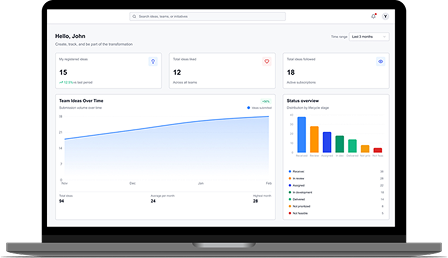
InsightFlow overviewInsightFlow overview

Problem statements

The platform captured ideas but did not support execution.

๐Ÿ—๏ธ

Key issues

  • Ideas were submitted but rarely implemented
  • Progress visibility was low
  • Leadership lacked tracking
  • Evaluation required manual interpretation
  • Trust declined over time
๐Ÿ“ˆ

As a result

  • High manual effort during evaluation
  • Slow decision cycles
  • Low conversion of ideas into executed initiatives
  • Reduced long-term engagement

This created a structural gap between idea capture and execution.

Organizational tensions

The redesign required aligning teams with different priorities and constraints.

โฑ๏ธ

Speed vs Structure

  • Commercial teams needed fast, low-effort submission
  • Operational teams needed structure and clarity to evaluate consistently
  • Risk: more structure could reduce adoption
๐Ÿง 

Visibility & governance

  • Leadership required visibility, traceability, and governance controls
๐Ÿ”

Launch pressure & cost constraints

  • Push for a full launch in June
    (vs. phased rollout)
  • Ongoing operational cost of ~R$150k/year (approx.)

How this shaped the strategy: we sequenced decisions to increase adoption first, then added structure through automation-improving governance without raising operational complexity.

Strategy

Instead of expanding features, the strategy focused on sequencing change:

  1. Increase adoption and reduce submission effort
  2. Improve evaluation consistency
  3. Scale decision workflows

This led to a phased redesign:

  • Phase 1: Frontline experience (Commercial teams)
  • Phase 2: Process unification & Automation (Operational teams)

The key principle:

Reduce effort before adding complexity

My role& Influence

My role & Influence
Scope: Led UX + product design across Phase 1โ€“2, from operating model to rollout.

Strategy & success metrics

  • Defined success criteria (adoption, throughput, processing cost)
  • Turned the vision into a phased roadmap with clear outcomes

Operating model & system design

  • Mapped end-to-end decision flows and ownership
  • Structured the evaluation architecture to reduce fragmentation and governance risk

Execution & rollout

  • Orchestrated rollout sequencing to increase adoption without adding friction
  • Drove cross-functional decisions with Product, Engineering, and Operations

Collaboration
Partnered closely with Product, Engineering, and Operational stakeholders to scale the system without increasing friction or governance risk.

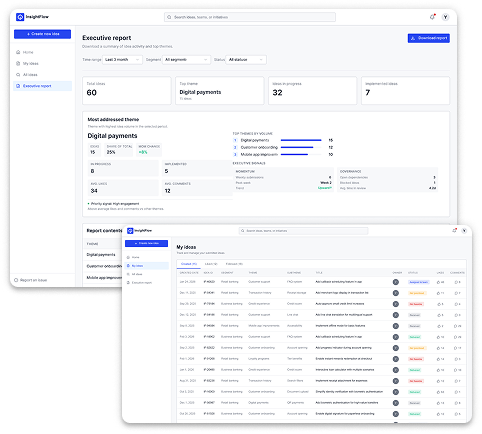
Roadmap phase 1

Throughout first and second quarter

  • Shipped: faster submissions, better visibility, higher adoption
  • Unlocked next: evaluation was still fragmented โ†’ Phase 2 focused on unification + automation
InsightFlow roadmap phase 1

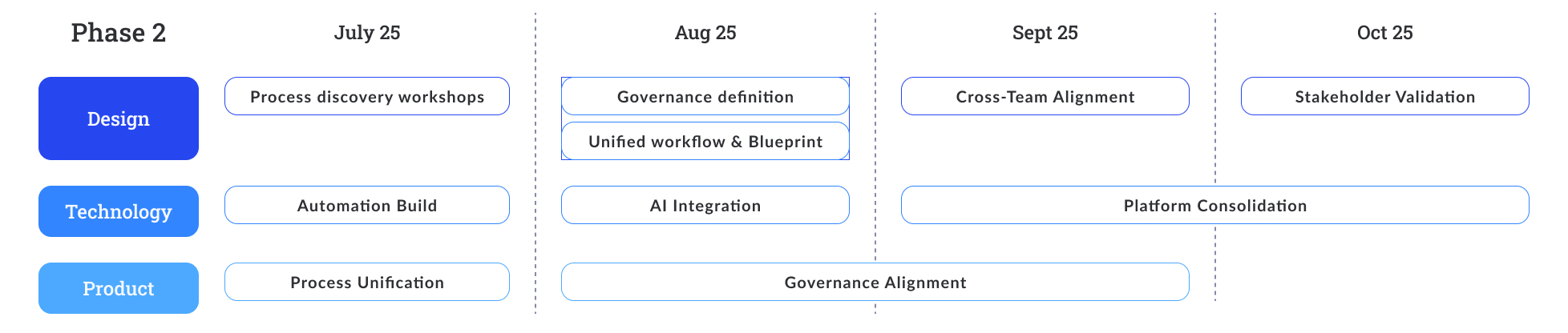
Roadmap phase 2

  • Stakeholders team evaluation workflows were fragmented across spreadsheets + chat, creating duplicated controls and low visibility.
  • Mapped friction with 5 process engineers and built a service blueprint to unify the workflow.
  • Centralized evaluation in one platform + AI-assisted triage (25 โ†’ 5 min, โˆ’80%), improving governance and throughput
InsightFlow roadmap phase 2
๐Ÿ’ผ

Phase 1 โ€” Frontline experience (Commercial teams)

  • Goal: increase 80% adoption from teams by reducing friction in the flow of work.

What we changed:

  • Faster idea capture with clearer inputs
  • Less effort to submit during real work contexts
    Success signal: more contributions, with higher-quality submissions.
โš™๏ธ

Phase 2 โ€” Process Unification
& Automation (Operational Teams)

  • Goal: scale evaluation and routing without increasing manual cost.

What we changed:

  • Unified stakeholder evaluation into one workflow
  • Automated routing for consistency and governance
    Success signal: faster decisions with clearer traceability.

Key decisions& Trade-offs

The platform allowed employees to submit ideas, but it did not effectively support execution.

โฑ๏ธ

Sequence adoption before structure

We prioritized information hierarchy and surfaced decision-critical fields first.

Trade-off: more structure improves evaluation but may reduce speed.

Decision: balance clarity with fast submission.

๐Ÿง 

Natural language input vs upfront forms

Users think in problems and opportunities, not categories.

We allowed natural-language input first and deferred categorization to later stages.

Trade-off: increased downstream processing, but higher adoption and better input quality.

๐Ÿ”

Progressive rollout to manage risk

Access expanded from
30% โ†’ 70% โ†’ 100% (40,000 users).

Trade-off: slower full release, safer scaling and faster learning loops.

What changed in the system

The platform had two phases solution:

๐Ÿ’ผ

Phase 1 โ€” Frontline experience (Adoption + Time efficiency)

  • Lightweight natural-language submission
  • Similar idea detection to reduce duplication
  • Engagement loops (like, comment, follow) to sustain interest
  • Clear statuses and notifications to reinforce trust

Impact: Reduced friction, improved participation, and increased journey completion.

โš™๏ธ

Phase 2 โ€” Operational teams

  • Structured workspace for reviewing and routing ideas
  • Clustering and classification workflows
  • Clear prioritization logic
  • Status updates and feedback loops
  • AI-assisted support for repetitive tasks, preserving human accountability

Impact: Reduced manual triage effort and improved evaluation consistency.

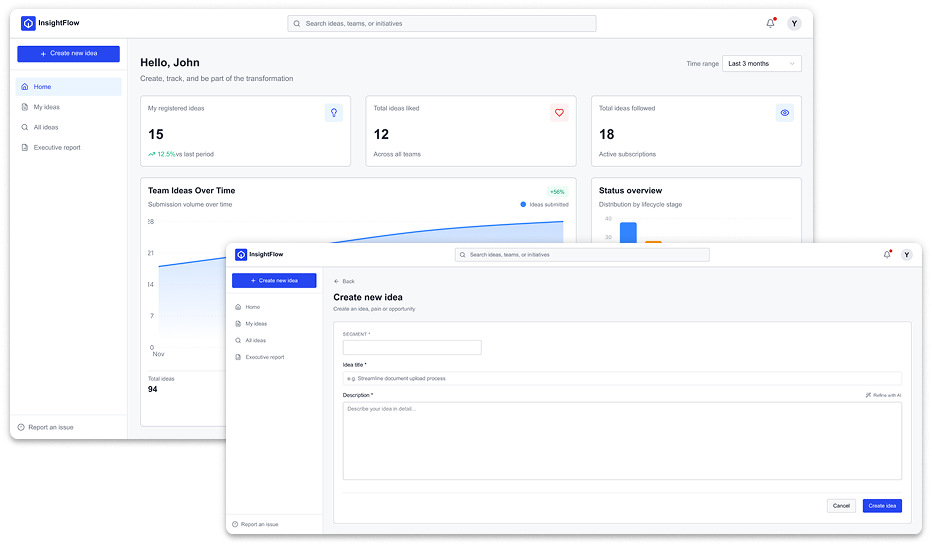
InsightFlow home dashboard and Create idea screen with AI theme categorization
โ€œHomeโ€ dashboard and โ€œCreate ideaโ€ Page: Validating creation and writing by AI. The agent categorizes the โ€œThemeโ€ and the โ€œSubthemeโ€ based on Description in the back-end.
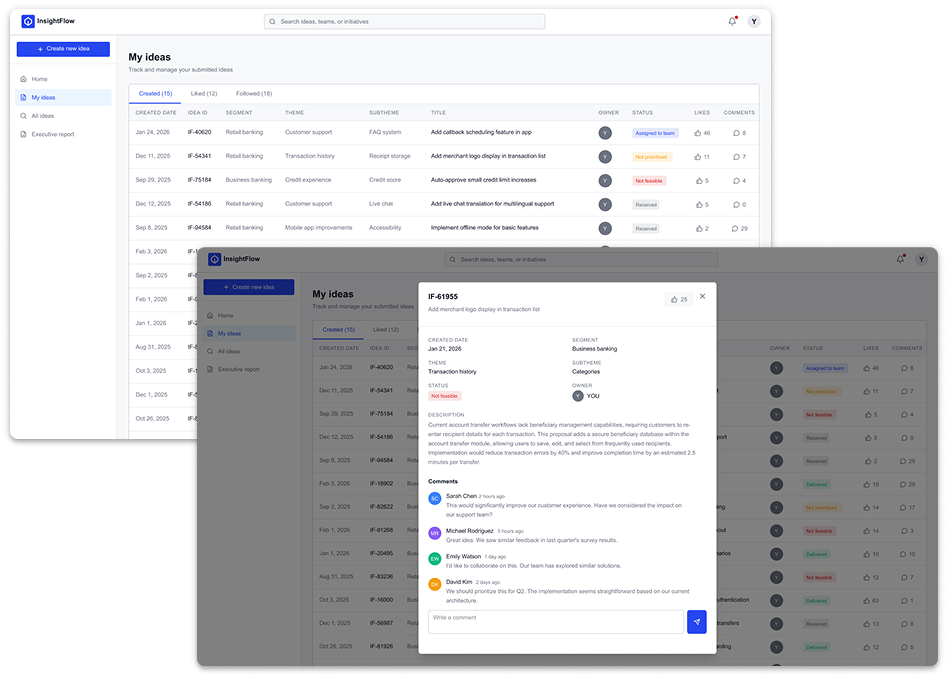
InsightFlow home dashboard and Create idea screen with AI theme categorization
โ€œMy ideasโ€ page and โ€œIdea visualizationโ€ modal. Validating the information hierarchy and the AI agent for โ€œThemeโ€ and โ€œSubthemeโ€.

Evidence& Results

What were our outcomes in production:

๐Ÿ‘ฅ

Adoption & User Behavior

Scaled from 12k โ†’ 40k users through phased rollout.

Results:

-87%

reduction in idea submission time

92

SUS score (validated usability and task completion)

  • Higher participation and continued contribution.
  • Clearer feedback loops increased trust and engagement.

Signal:
Stronger adoption and improved journey completion.

โš–๏ธ

Operational Efficiency & Decision Throughput

70%

AI summarization to reduce reading effort

25min
5min

reduced 80% idea filtering time

  • Reduced manual evaluation effort
  • Structured routing improved decision clarity.
  • AI classification implemented in production.
  • Unified teams evaluation workflows.

Signal:
Faster decision cycles and lower operational processing cost.

๐Ÿ“ˆ

Business Impact & ROI

50%

reduction in recurring platform cost

R$151kR$75k

annual operational cost reduced 50%

  • Achieved while scaling adoption to 40k users.
  • Reduced dependency on legacy contract.
  • Improved cost-efficiency aligned with AI + FinOps principles.

Signal:
Higher operational efficiency and improved ROI without sacrificing governance or performance.

AI + FinOps alignment

AI was used to reduce operational effort while preserving performance and governance.

In production:

  • Automated classification.
  • Faster theme detection.

Future opportunity:

  • Centralized AI usage internally.
  • Reduced external tooling dependency.
  • Improved governance control.

What changed structurally

Structural shift: from idea intake to an execution-ready operating model.

Increased adoption without adding friction.

Reduced processing cost through a unified evaluation workflow.

Improved decision clarity across teams without increasing system complexity.

Next steps

Now (0โ€“4 weeks) โ†’ Next (1โ€“2 months) โ†’ Later (quarter+)

Improve edge-case operational flows (Now)

Strengthen decision traceability (who/why/when) (Next)

Reduce feedback latency from capture โ†’ review (Next)

Expand AI summarization for evaluations (Later)

Add adoption + throughput dashboards (Later)

Nextfin: Financial clarity that drove +34% signupsZool: From insight to launch, B2B GTM journey